
Devlog Week 2: Relations, DAOs & Exception Handling#
So, welcome to this second entry of my Devlog. Without further ado, let’s continue into this week’s additions.
Relations, DAOs and exception handling#
This week’s primary goal was to get the necessary relations between my entities up and running, begin to finalize the DAOs for each, and integrate interfaces both for simple CRUD and for specific queries across the board. After that, the project looked a bit like this:
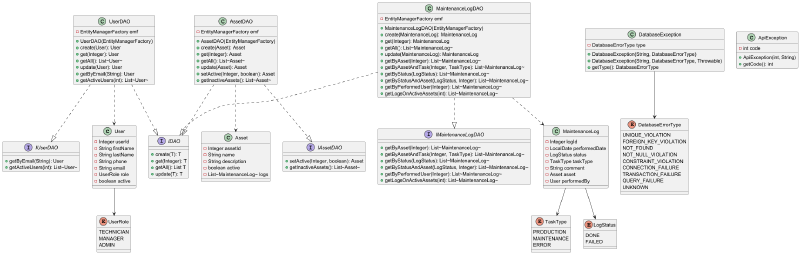
After that I began to add exception handling across my different CRUD operations. I made the design choice of adding my own custom DatabaseException class with some error types I can relate to common HTTP error codes, both to keep low coupling between layers and to have the correlation I need when I start to use APIException in the service layer to interpret DatabaseExceptions. For reference, I have thrown in my current custom exception, the error type enum and an example of how it’s used in the code:
public enum DatabaseErrorType
{
    CONSTRAINT_VIOLATION , // 409
    NOT_FOUND, // 404
    CONNECTION_FAILURE, // 503
    TRANSACTION_FAILURE, // 500
    QUERY_FAILURE, // 500
    UNKNOWN
}
public class DatabaseException extends RuntimeException {
private final DatabaseErrorType errorType;
public DatabaseException(String message, DatabaseErrorType errorType) {
super(message);
this.errorType = errorType;
}
public DatabaseException(String message, DatabaseErrorType errorType, Throwable cause) {
super(message, cause);
this.errorType = errorType;
}
public DatabaseErrorType getErrorType() {
return errorType;
}
}@Override
public User update(User u)
{
if (u == null || u.getUserId() == null)
{
throw new IllegalArgumentException("User and user id are required");
}
try (EntityManager em = emf.createEntityManager())
{
em.getTransaction().begin();
try
{
User merged = em.merge(u);
em.getTransaction().commit();
return merged;
}
catch (IllegalArgumentException e)
{
if (em.getTransaction().isActive())
{
em.getTransaction().rollback();
}
throw new DatabaseException("User not found or invalid", DatabaseErrorType.NOT_FOUND, e);
}
catch (PersistenceException e)
{
if (em.getTransaction().isActive())
{
em.getTransaction().rollback();
}
throw new DatabaseException("Update User failed", DatabaseErrorType.TRANSACTION_FAILURE, e);
}
catch (RuntimeException e)
{
if (em.getTransaction().isActive())
{
em.getTransaction().rollback();
}
throw new DatabaseException("Update User failed", DatabaseErrorType.UNKNOWN, e);
}
}
}Who needs to know about whom?#
One of the more interesting design decisions I had while working on the project this week was about relationships — specifically, which entities in my domain model need to know about each other, and which ones don’t.
It sounds obvious when you say it out loud, but it’s one of those things that’s easy to just… not think about, and then end up with a bloated model where everything points to everything else for no good reason.
Asset ↔ MaintenanceLog (Bidirectional)
This one was a clear yes for bidirectional. An asset needs to know about its logs because the whole point of the system is reviewing an asset’s maintenance history. You land on an asset, and you expect to see its logs right there.
// Asset side
@OneToMany(fetch = FetchType.LAZY, mappedBy = "asset")
@OrderBy("performedDate DESC")
private List<MaintenanceLog> logs = new ArrayList<>();

// MaintenanceLog side (owning side)
@ManyToOne(fetch = FetchType.LAZY, optional = false)
@JoinColumn(name = "asset_id", nullable = false)
Asset asset;
The MaintenanceLog owns the relationship (it holds the foreign key), but Asset can still navigate to its logs. The @OrderBy annotation means they always come back newest first, without me having to sort anything manually.
MaintenanceLog → User (Unidirectional)
This one was a deliberate choice to not go bidirectional. A log needs to know who performed it — that’s just part of the audit trail. But does a User need a list of all the logs they’ve ever written?
In practice, no — at least not in the way this system works. If you want logs by a specific user, you go through the MaintenanceLogDAO and query directly. You don’t navigate there through the User entity. Keeping it unidirectional keeps User clean and focused.
// MaintenanceLog side only — User has no collection of logs
@ManyToOne(fetch = FetchType.LAZY, optional = false)
@JoinColumn(name = "performed_by_user_id", nullable = false)
User performedBy;
The question I found most useful to ask myself throughout all of this was: “Will I ever need to navigate this relationship from the other direction in a realistic use case?”
Not “could I imagine a scenario where…”, but actually, in the flow of this application, does it make sense? For assets and logs: yes, absolutely. For users and logs: no, you query for that directly.
It’s a small thing, but keeping relationships unidirectional where possible means less to maintain, less risk of accidentally triggering lazy loading where you don’t want it, and a domain model that actually reflects how the system gets used — rather than just how it could be used in some hypothetical future.
Anyway, small win for thinking before just annotating everything with @OneToMany and calling it a day.
And finally a quick rundown of my current design decisions:
Maintenance Log - Design Decisions (Updated)#
Updates Since Last Summary#
Current state: DAO layer mostly complete will probably need to make more specific queries later when the need arises, integration tests planned next.
Major Design Changes#
1. Asset Fetch Strategy Changed Back to LAZY
- Previous:
FetchType.EAGERonAsset.logs - Current:
FetchType.LAZYonAsset.logs - Why changed back: EAGER would load all logs for all assets in list queries (performance concern)
- Solution: Use explicit queries when logs are needed, rely on lazy loading otherwise
2. Added Helper Method to Asset
- Implementation:
Asset.addLog(MaintenanceLog log)helper method added - Previous decision: No helper methods needed for stateless REST API
- Why changed: Provides convenient way to maintain bidirectional relationship consistency
- Usage: Optional convenience method, not required for persistence
3. Asset.logs Collection Initialized
- Implementation:
private List<MaintenanceLog> logs = new ArrayList<>() - Rationale: Prevents
NullPointerExceptionwhen usingaddLog()helper method
4. Added @OrderBy to Asset.logs
- Implementation:
@OrderBy("performedDate DESC") - Rationale: Logs always returned in chronological order (newest first) without manual sorting
5. Asset Entity Now Has Selective Mutability
Implementation: Only
activefield has@Setter, other fields immutable after creationRationale:
nameanddescriptionshouldn’t change (audit trail)activestatus needs to change (deactivation workflow)- ID never changes (automatically generated)
6. Comprehensive Exception Handling Added to DAO Layer
Implementation: All DAO methods now wrap JPA exceptions in custom
DatabaseExceptionPattern:
- Input validation throws
IllegalArgumentException(e.g., null checks) - Read failures throw
DatabaseExceptionwithQUERY_FAILUREerror type - Write failures throw
DatabaseExceptionwithTRANSACTION_FAILUREerror type - “Not found” scenarios throw
DatabaseExceptionwithNOT_FOUNDerror type
- Input validation throws
Transaction safety: All write operations include proper rollback on any exception
Rationale:
- Decouples persistence layer from JPA implementation details
- Provides consistent exception interface for service layer
- Maps cleanly to HTTP status codes without exposing persistence concerns
- Distinguishes between different failure types for better error handling
DAO Method Additions:#
MaintenanceLogDAO:
getByPerformedUser(Integer userId)— cross-user log queriesgetLogsOnActiveAssets(int limit)— filtered + paginated queries
UserDAO:
getActiveUsers(int limit)— paginated active users query
AssetDAO:
setActive(Integer id, boolean active)— only allowed mutationgetInactiveAssets()— query deactivated assets
Structural Changes:#
- Removed Task entity entirely
- Added TaskType enum
- Reorganized project structure into separate packages
- Added DAO interfaces layer
- Standardized exception handling across all DAOs
- Removed unnecessary
new ArrayList<>()wrapping in DAO return statements
1. Immutability of Maintenance Logs#
- Decision:
MaintenanceLogentries are never updated or deleted - Implementation:
MaintenanceLogDAOhas NOupdate()method — throwsUnsupportedOperationException - Rationale: Data integrity and traceability (GDPR compliance, audit trail)
- Future consideration: Log corrections will reference previous entries (handled in service/GUI layer)
2. Soft Delete for Users#
- Decision: Users are deactivated, not deleted (
activeboolean field) - Implementation:
User.activefield added- No
delete()method inUserDAO update()method used to setactive = false
- Rationale: Preserve historical data — maintenance logs need to show who performed them, even after users leave
3. Immutability of Assets (with Exception)#
- Decision: Assets are immutable except for
activestatus - Implementation:
- Only
activefield has@Setteron entity nameanddescriptionhave no setters (immutable)AssetDAO.update()throwsUnsupportedOperationExceptionAssetDAO.setActive(Integer id, boolean active)allows only status changes- Uses
find()+ setter pattern, notmerge()
- Only
- Rationale:
- Asset details (name, description) should not change for audit trail
- Active status needs to change for operational/deactivation workflow
- Maintains data integrity while allowing necessary state management
4. Task System Redesigned as Enum#
- Decision: Removed
Taskentity, replaced withTaskTypeenum - Implementation:
  public enum TaskType {
      PRODUCTION,
      MAINTENANCE,
      ERROR
}- Previous design: Task entity with title and description
- Why changed:
- Task descriptions are unique per log (technician writes what they did)
- Only the category (title) is predefined
- Enum is simpler, type-safe, and matches actual use case
- Specific work details go in
MaintenanceLog.commentfield (nownullable = false)
- Rationale: Eliminates unnecessary entity and relationship, clearer domain model
5. Entity Relationships#
MaintenanceLog relationships:#
@ManyToOnetoAsset(owning side,LAZYloading)@ManyToOnetoUser(owning side,LAZYloading)- All relationships:
nullable = false - Changed: Removed
@ManyToOneto Task (now usesTaskTypeenum)
Asset relationship:#
@OneToManytoMaintenanceLog(non-owning side)mappedBy = "asset"LAZYloading@OrderBy("performedDate DESC")— automatic chronological sorting- Initialized to empty
ArrayList<>()to prevent NullPointerException - Optional helper method:
addLog(MaintenanceLog log)for bidirectional consistency - No setter on collection (relationship managed via
MaintenanceLogcreation or helper method)
User relationship:#
- Unidirectional from
MaintenanceLogtoUser - User entity has no collection of logs
- Rationale: Logs are accessed via Asset or direct queries, not via User
6. Helper Methods on Entities#
- Decision:
Asset.addLog(MaintenanceLog log)helper method added - Previous decision: No helper methods needed
- Why changed: Provides convenient way to maintain bidirectional consistency if needed
- Usage: Optional — not required for persistence, can still manage via MaintenanceLog side only
- Implementation: Sets both sides of relationship (
logs.add(log)andlog.setAsset(this))
7. DAO Layer Responsibilities and Architecture#
DAOs are “dumb persistence” — no business logic#
Responsibilities:
- CRUD operations
- Database queries via JPQL
- Exception wrapping (convert JPA exceptions to
DatabaseException) - Input validation (
IllegalArgumentExceptionfor null/invalid inputs)
Not responsible for:
- Validation (service layer)
- Business rules (service layer)
- HTTP concerns (controller layer)
DAO Interfaces#
- Implementation: Separate interfaces (
IDAO<T>,IUserDAO, etc.) for each DAO - Rationale:
- Contract separation for testing
- Interface Segregation Principle
- Allows mocking in future tests
8. Exception Handling Strategy#
Custom Exception Hierarchy#
public class DatabaseException extends RuntimeException {
    private final DatabaseErrorType errorType;
}

public enum DatabaseErrorType {
    CONSTRAINT_VIOLATION,  // 409
    NOT_FOUND,            // 404
    CONNECTION_FAILURE,   // 503
    TRANSACTION_FAILURE,  // 500
    QUERY_FAILURE,        // 500
    UNKNOWN
}
Exception Rules#
- “Not found” throws exceptions (not returns null)
- Rationale: In this system, looking up by ID is expected to succeed (IDs from database)
- Failed lookup indicates something went wrong (deleted, corrupted)
- Service layer catches and converts to appropriate HTTP responses
- Read operations (
SELECT) →DatabaseErrorType.QUERY_FAILURE - Write operations (
INSERT,UPDATE) →DatabaseErrorType.TRANSACTION_FAILURE - Rationale: Clear distinction helps service layer understand failure type
- Input validation →
IllegalArgumentException(notDatabaseException)
Transaction Management#
- Write operations: Explicit transaction with proper rollback on all exception types
- Read operations: No transaction needed
- Pattern:
  em.getTransaction().begin();
  try {
      // operation
      em.getTransaction().commit();
  } catch (PersistenceException e) {
      if (em.getTransaction().isActive()) {
          em.getTransaction().rollback();
      }
      throw new DatabaseException(..., TRANSACTION_FAILURE, e);
  }
9. Query Strategy#
- Primary key lookups: Use
em.find()(simpler, cached, returns null)- Then check null and throw
DatabaseExceptionwithNOT_FOUND
- Then check null and throw
- Other queries: Use JPQL with
TypedQueryand named parameters - getSingleResult() handling: Catch
NoResultException, rethrow asDatabaseException - No unnecessary wrapping: Return
query.getResultList()directly (removednew ArrayList<>()wrapper)
10. User Authentication Considerations#
- Decision:
UserDAO.getByEmail()filters byactive = true - Rationale: Only active users can log in
- But:
UserDAO.get(userId)returns all users (active or not) - Rationale: Historical lookups need to show inactive users (who performed a log)
11. Field Protection#
- Decision: Manual
@Setterannotations on individual fields - Primary keys: NO setter (immutable after creation)
- Immutable entities (Asset): Only
activefield has setter - Mutable entities (User): All fields except ID have setters
- Rationale: Prevents accidental ID modification and enforces immutability where needed
12. Email Uniqueness#
- Decision: Database-level constraint + service-layer validation
- Implementation:
@Column(unique = true)onUser.email - Rationale: Defense in depth — database prevents duplicates, service layer provides better error messages
13. Merge vs. Find Pattern for Updates#
- Decision: Use
find()+ setter, notmerge()with partial entities - Implementation:
  Asset asset = em.find(Asset.class, id);
  asset.setActive(active);
// commit auto-flushes- Rationale:
- Prevents accidentally clearing other fields
- More explicit about what’s being changed
- No need for defensive find-before-merge
- Clearer intent
14. Fetch Strategy#
- Asset.logs:
LAZYloading with@OrderBy("performedDate DESC")- Rationale: Prevents loading all logs when listing assets
- Ordering: Always returns logs newest-first without manual sorting
- Access: Explicit queries or navigation through relationship when needed
- All MaintenanceLog relationships:
LAZYloading
15. GetAll() Methods#
- Decision: Included in all DAOs despite potential performance issues
- Rationale: School project requirement to demonstrate functionality
- Implementation:
AssetDAO.getAll()only returns active assets- Some methods have
limitparameter for pagination (e.g.,getActiveUsers(int limit))
- Note: Should be paginated for production use
Architecture Layers (Planned)#
┌─────────────────────────────────┐
│   REST API (Javalin)            │  ← HTTP status codes
├─────────────────────────────────┤
│   Service Layer                 │  ← Business rules, validation
├─────────────────────────────────┤
│   DAO Layer (Current)           │  ← Database operations
├─────────────────────────────────┤
│   JPA/Hibernate                 │
├─────────────────────────────────┤
│   PostgreSQL                    │
└─────────────────────────────────┘